


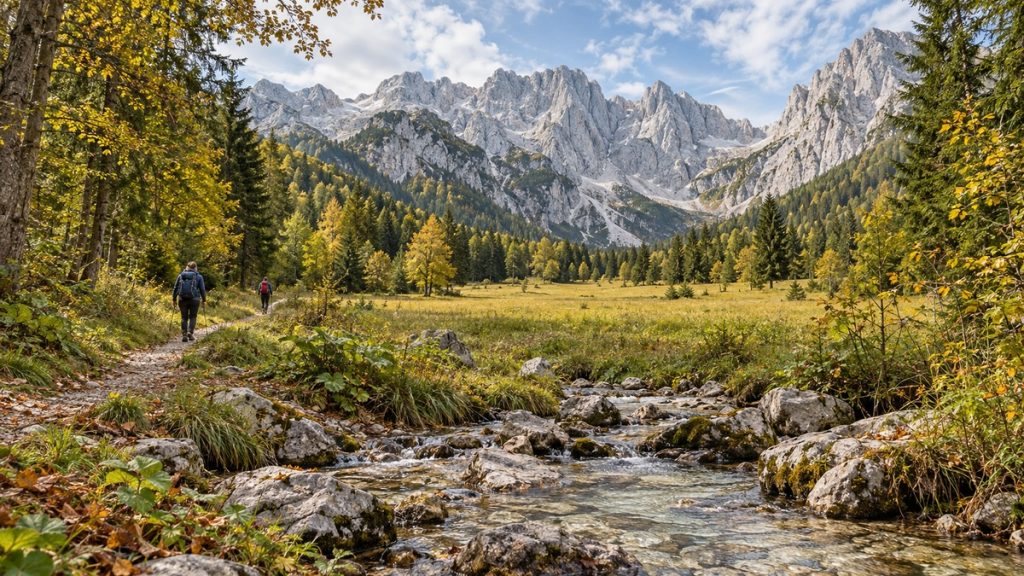
Picture a river running clear and aquamarine over pale stone, a 300-foot waterfall bursting from a cliff, and a log-cabin pub pouring wild-fermented wine before the trail climbs into the peaks. Those stops help define Slovenia’s Kamnik-Savinja Alps Water Trail, a route built around water rather than summits.
- A 191-mile loop split into 11 stages, linking rivers, lakes, springs, and historic villages.
- Connected in 2023 after a 2022 project mapped 54 pristine springs across the range.
- Designed for scenery, swimming holes, and local food instead of hard peak-bagging.
Water Instead of Peaks
The Kamnik-Savinja Alps Water Trail, or KSAWT, wraps around Slovenia’s second largest mountain range in a loop that celebrates its rivers, lakes, and springs. The 191-mile route stitches together more than a dozen historic villages and towns, plus three lakes, four rivers, a scatter of waterfalls, and over 200 springs and streams.
The path skips the brutal high summits. Instead of forcing hikers up 8,392-foot Grintovec, it favors accessible valleys, meadows, and the banks of the waterways flowing through them. It still climbs, most memorably to the overlook above Rinka Waterfall, but the mood leans toward soaking in views and cooling off in a swimming hole rather than gritting your teeth up scree.
The Logar Valley and Rinka Falls
The scenery reads like a fantasy film set. The trail passes through the 3,000-foot-high Logar Valley, where gnarled apple trees and wildflowers edge long, narrow fields of green grass and knobby conifer forests roll toward snow-capped peaks. Old stone and plaster homes with low shake roofs cluster near the treeline.
Follow the upper Savinja River as the valley narrows into silvery linden and elm, and you’ll reach a tiny log-cabin pub serving berry liquors and Carniolan sausage plates near the entry to the cirque. Climb the stairs and Rinka Waterfall erupts from a notch in the sheer rock, dropping about 300 feet into a bright blue pool. A cantilevered hike-in café clings to the escarpment partway up the falls, and a Scandinavian-style mountaintop lodge run by the Alpine Association of Slovenia gives thru-hikers a comfortable place to sleep.
Fewer Crowds, More Room
Slovenia has quietly earned a reputation as one of Europe’s hidden gems for long-distance walkers. The country sits about the size of Massachusetts, tucked against Northern Italy to the west and Austria to the north, yet it holds roughly 6,200 miles of hiking trails. That’s a lot of space for its trekker tourists to spread out, which is exactly the appeal for people looking for quieter alpine trails rather than the human traffic jams found on Europe’s busiest routes.
The water trail grew out of a 2022 effort to map and protect the region’s springs. Local groups, conservationists, the Slovenian Tourist Board, and a European agricultural network identified 54 pristine sources, including carbonated iron and mineral springs. They added hardened treads, stone headwalls, and spring boxes to both welcome and protect the sites, then connected everything into the KSAWT in 2023. Signs along the way explain the geology and history of each fount.
Tasting Your Way Around the Loop
The food and drink are half the reward. These mountains have worked like a natural water tower for millennia, and that clean water shapes the local wine, beer, and spirits. The wines lean on older grape varietals and old techniques like whole-cluster fermentation and native yeasts, giving hikers flavors to compare with more familiar wines. Pair them with cured meats like zgornjesavinjski želodec or Trnič cheese, shaped by shepherds up on the Velika Planina plateau.
There’s even a playful challenge built in. Hikers are encouraged to sip from different springs and try to notice the subtle differences, then compare their guesses against posted mineral breakdowns and tasting notes. It’s an unusual quiet alternative to Europe’s busiest hikes, one that turns a water break into a small game.
Planning a Walk of Your Own
If this trail lands on your list, treat the details as a starting point rather than a promise. Stage difficulty varies, conditions change with the season, and shuttle service, hut space, and spring water quality aren’t guaranteed at every stop. Prepare for a mountain hike, check current route information, pack for changing weather, and confirm whether water is safe to drink where you plan to fill up. A quieter reputation does not mean an empty trail, especially at popular stops. Do that groundwork, and a slow loop through Slovenia’s valleys becomes one of the more rewarding walks in Europe.
For more Slovenian mountain scenery, the accompanying video visits the Julian Alps and Soča Valley, separate from the Kamnik-Savinja Water Trail.
