

How Downhill Speed Control Works on Trails and Ramps
Pointing a truck or SUV down a steep, loose slope is one of those moments when your right foot suddenly feels clumsy. Press the brake too hard and the tires can lock and slide. Press too lightly and the vehicle starts to run away from you. Automatic descent control was built for exactly that moment, and it’s a lot less mysterious once you see how it works.
- Descent control automatically applies the brakes to help limit your speed on a steep downhill, so you can focus on steering.
- In Honda’s version, you can adjust the crawl between roughly 2 and 12 mph with the gas and brake pedals, though other models vary.
- On a boat ramp, don’t rely on it unless your owner’s manual confirms it works in reverse while towing, and be ready to brake yourself.
What the System Is Doing Under You
From the driver’s seat, the effect is simple. You switch the system on, start down a steep grade, and the vehicle applies its own brakes to help keep your speed from building. How it decides when to step in, and which buttons or settings you use, varies by make and model.
Honda offers a useful example of the braking side. Its system watches how fast each wheel is spinning. When one turns at a different rate than the others, that hints at slip, so the brake on that wheel is managed separately to help keep it from locking. Tires that keep rolling are far easier to steer than tires that skid.
Using Your Feet to Set the Pace
You aren’t stuck with whatever speed you started at. In Honda’s setup, the working range runs from about 3 to 20 km/h, roughly 2 to 12 mph. Ease onto the gas to go faster or tap the brake to slow down. When you lift your foot, your current speed becomes the new setting. Other brands may differ.
To turn off Honda’s system, press the button again or accelerate to 60 km/h, about 37 mph. Honda also notes the system might not kick in on gentle slopes, since it’s meant for real downgrades.
Low-range gearing can help a vehicle crawl downhill with more control. That doesn’t mean descent control will run alongside it, though. Check the owner’s manual to see whether it can operate in low range on your vehicle.
Where It Earns Its Keep on the Trail
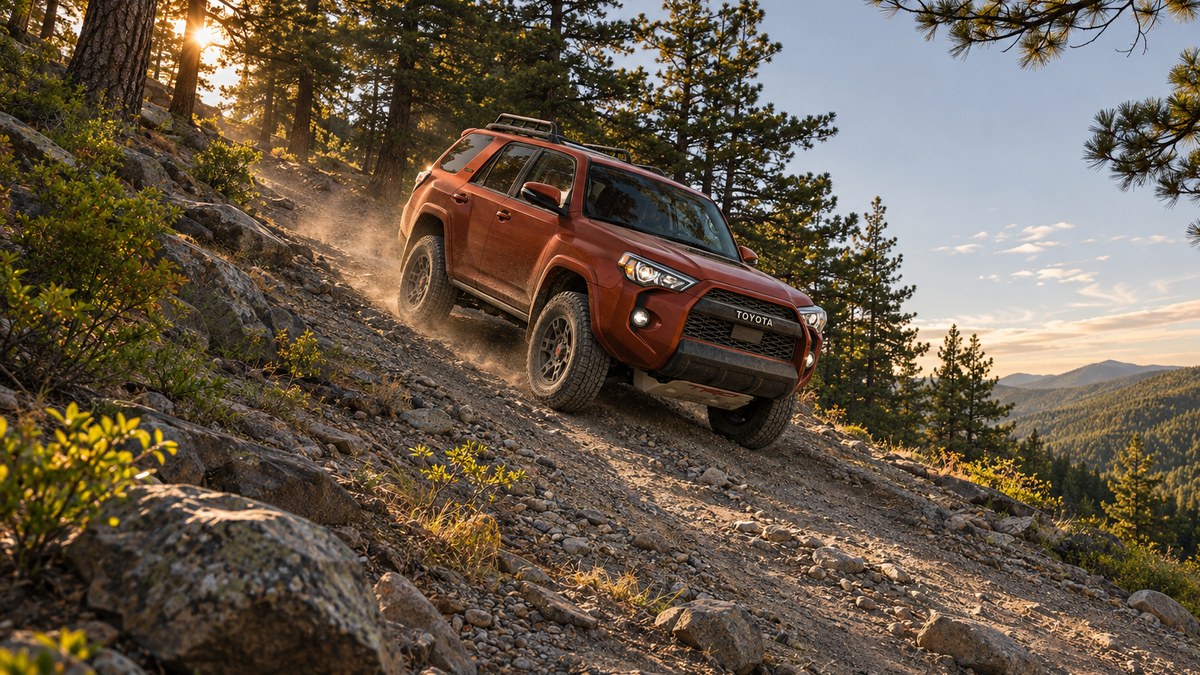
Picture a steep, rocky descent with loose ground and a drop on one side. Steep, rough downgrades are what this tech is aimed at, though very slippery footing can still overwhelm it.
Stop at the top and pick your line. Switch the system on, set a slow crawl, and let the car manage the speed while you aim it. Keep your foot near the brake anyway.
Boat Ramps: Check Before You Count on It
A launch ramp slopes downward and is often wet or slick, so it can look like a natural fit. The catch is that launching usually means backing a trailer down the incline. Don’t rely on descent control here unless your owner’s manual confirms that it works in reverse while towing.
Even when the manual gives the green light, stay ready to brake yourself. Honda states plainly that the system can’t hold a constant speed in every condition, and that on very steep or slippery surfaces it may not keep the speed steady at all. A slick ramp is exactly that kind of surface. No descent system adds traction. It only helps you use what’s already there. Back slowly. If someone is guiding you, settle on signals before you start, and have that person stand within your view and well clear of the path your tow vehicle and trailer will take. If you lose sight of them, stop.
Trust the Crawl, but Keep Your Eyes Up
Descent control is a handy tool for the moments when smooth braking by foot gets hard. Get comfortable with it on an easy, empty slope first. Learn where the button is, how your vehicle signals that it’s working, and how to switch it off. Read what your manual says about low range, reverse and towing. Then on a steep trail, you’ll know what the car can handle and what’s still on you.